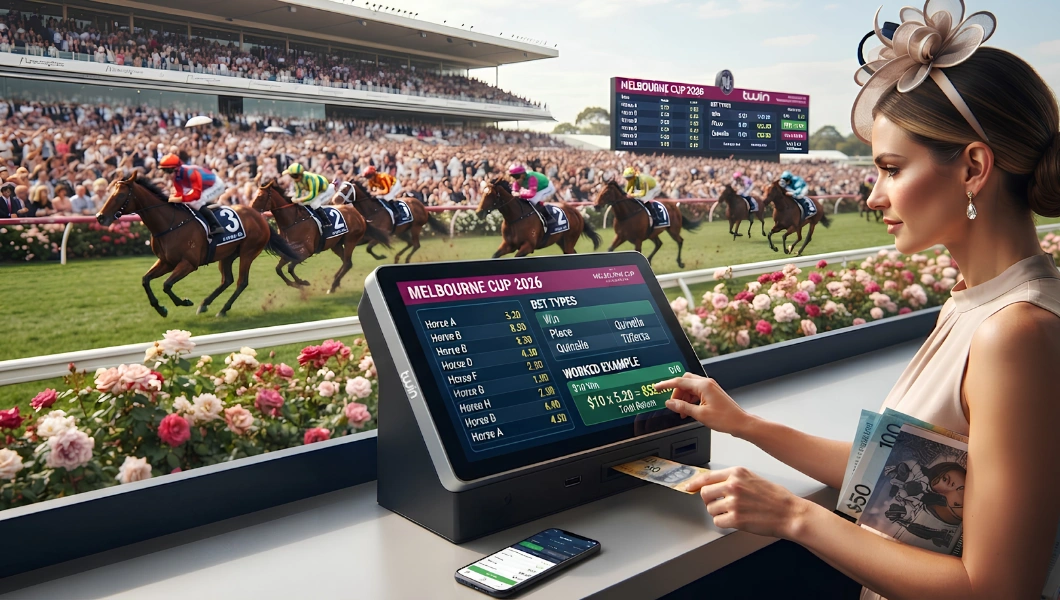
Melbourne Cup Betting Guide 2026: Odds, Bet Types and Worked Examples
The Melbourne Cup is the one race of the year that almost every Australian has a stake in, whether that is a $5 office sweep or a carefully built trifecta. This guide explains how the race works, how to read Melbourne Cup odds, what every bet type actually pays, and how to keep your Cup day spending under control. Every example below uses simple numbers you can check yourself.
Last updated: 6 October 2026. Fields, barriers and odds for the 2026 race are not final yet; we will update this page once the field is confirmed.
Who this guide is for: first-time punters who want to understand the basics before Cup day, and regular punters who want a clear reference for exotic bets, flexi percentages, place terms and scratching deductions.
Melbourne Cup 2026: Key Facts at a Glance
| Detail | 2026 Melbourne Cup |
|---|---|
| Date | Tuesday 3 November 2026 |
| Venue | Flemington Racecourse, Melbourne |
| Distance | 3200 metres |
| Race type | Group 1 handicap (horses carry different weights) |
| Prize money | $10 million total |
| Maximum field | 24 runners |
| Usual start time | Around 3:00pm AEDT (confirm on race day) |
| First run | 1861 |
Source: Victoria Racing Club. Start times can change, so always check the official race card.
Key Takeaways
- The Cup is a handicap: better horses carry more weight, which is why favourites often start at $6.00 or longer and roughhies regularly run into the placings.
- Decimal odds show your total return per $1, including your stake. $21.00 means a $10 bet returns $210.
- Each way is two bets (win and place), so a $10 each-way bet costs $20.
- Exotics (quinella, exacta, trifecta, first four) can pay big, but the number of combinations multiplies quickly. Flexi betting lets you cover more runners for a smaller outlay.
- Set your Cup day budget before you look at the form, and only bet with a bookmaker licensed in an Australian state or territory.
How the Melbourne Cup Works
The Melbourne Cup is a 3200m staying race for horses aged three and older. Because it is a handicap, the handicapper assigns each horse a weight based on its past performances. The aim is to give every runner a fair chance, which is a big reason the Cup is so hard to pick and why the betting market is usually wide open.
Up to 24 horses can start. If more horses are nominated and accepted than there are places, a ballot decides who gets in. Some horses are ballot-exempt because they won a nominated lead-up race (the VRC calls these “Golden Ticket” races). Everyone else is ranked on factors such as recent prize money and wins or placings in lead-up races. Up to four emergencies are also named, and they can take the place of a horse that is scratched before the cut-off.
The Road to the Cup: Lead-Up Races to Watch
Most Cup runners have a final lead-up run in the weeks before the race. Watching how they finish these races (and how they pull up afterwards) is one of the most useful form clues you can get.
| Race | Track and distance | 2026 date | Why it matters |
|---|---|---|---|
| Caulfield Cup | Caulfield, 2400m (handicap) | Saturday 17 October | The most important handicap guide to the Cup. Strong finishers over 2400m often have the stamina for 3200m. |
| Geelong Cup | Geelong, 2400m | Mid October | A Golden Ticket race in 2026; the winner earns ballot exemption. |
| Cox Plate | Moonee Valley, 2040m (weight-for-age) | Saturday 24 October | A shorter, elite race. Few Cup horses run in it, but a strong Cox Plate run shows class. |
| Moonee Valley Gold Cup | Moonee Valley, 2500m | Late October | A newer Golden Ticket race for 2026 with ballot exemption for the winner. |
| Lexus Stakes | Flemington, 2500m | Saturday 31 October (Derby Day) | The last chance to earn ballot exemption. Run on the Cup track three days before the big race. |
Dates for the Geelong Cup and Moonee Valley Gold Cup are given as a window; check the official racing calendar for exact days.
How to Read Melbourne Cup Odds
Australian bookmakers display decimal odds. The number shows how much you get back for every $1 you bet, including your stake. To work out your total return, multiply your stake by the odds. To find your profit, subtract your stake.
Example: a $10 win bet on a horse at $21.00 returns $10 x 21 = $210 if it wins. Your profit is $200.
Odds also tell you the implied probability, which is the chance the market is giving that horse. Divide 1 by the odds: 1 / 21 = 0.048, or about 4.8%.
| Decimal odds | Return on a $10 win bet | Profit | Implied chance |
|---|---|---|---|
| $3.00 | $30 | $20 | 33.3% |
| $6.00 | $60 | $50 | 16.7% |
| $11.00 | $110 | $100 | 9.1% |
| $21.00 | $210 | $200 | 4.8% |
| $31.00 | $310 | $300 | 3.2% |
| $51.00 | $510 | $500 | 2.0% |
| $101.00 | $1,010 | $1,000 | 1.0% |
Want to try your own numbers? Use our betting odds calculator.
Why the Odds Add Up to More Than 100%
If you add up the implied chances of every horse in a Cup market, the total will be well above 100%. The extra is the bookmaker’s margin (also called the overround). Early Cup markets, which open months before the race, tend to carry bigger margins than the final market on race morning. This means the price on offer is always a little shorter than the horse’s “fair” chance, which is one reason most punters lose over time.
Melbourne Cup Bet Types Explained
Here is every common Cup bet in one place. Win, place and each-way bets are the simplest. Quinella, exacta, trifecta and first four are called exotics because you need to pick several horses in the right finishing positions.
| Bet type | You win if | Difficulty | Best for |
|---|---|---|---|
| Win | Your horse finishes 1st | Easy | Backing one horse you really like |
| Place | Your horse finishes in the top 3 (top 3 places for fields of 8 or more on the tote; some bookmakers pay extra places on Cup day as a promotion) | Easy | Safer returns on longer-priced horses |
| Each way | Two bets: one win and one place, equal stakes | Easy | Roughies that could run into a placing |
| Quinella | Your 2 horses finish 1st and 2nd in any order | Medium | Two horses you rate highly |
| Exacta | Your 2 horses finish 1st and 2nd in exact order | Hard | A confident view on the winner and runner-up |
| Trifecta | Your 3 horses finish 1st, 2nd and 3rd in exact order | Hard | The most popular Cup exotic |
| First Four | Your 4 horses finish 1st to 4th in exact order | Very hard | Large dividends for a small outlay |
| Multi | Two or more selections across different races all win | Hard | Linking the Cup with other races on the card |
Win and Place: Worked Example
You put $10 to win on a horse at $11.00 and $10 for a place at $3.20. Your total outlay is $20.
- It wins: win bet returns $110, place bet returns $32. Total return $142.
- It runs 2nd or 3rd: win bet loses, place bet returns $32. Total return $32.
- It finishes 4th or worse: both bets lose. You are $20 down.
Each Way: Worked Example
An each-way bet is simply a win bet and a place bet of the same size. A “$10 each way” bet costs $20.
Say you take $10 each way on a $21.00 horse, and the bookmaker’s place price is $5.20 (place prices differ between bookmakers, so always check before you bet):
| Result | Win bet ($10 at $21.00) | Place bet ($10 at $5.20) | Total return | Profit or loss |
|---|---|---|---|---|
| Wins | $210 | $52 | $262 | +$242 |
| Runs 2nd or 3rd | $0 | $52 | $52 | +$32 |
| Finishes 4th or worse | $0 | $0 | $0 | -$20 |
Example prices only. They are not 2026 Melbourne Cup odds.
Tip: each way makes most sense on horses at longer odds. On a $4.00 favourite, the place price may be so short that a placing barely covers your total outlay.
Exotic Bets: How Many Combinations Are You Buying?
When you box horses in an exotic, you are buying every possible finishing order of those horses. Each order is one combination. At 100% (a $1 unit), the cost of the bet is simply the number of combinations.
| Horses boxed | Quinella | Exacta | Trifecta | First Four |
|---|---|---|---|---|
| 2 | 1 | 2 | Not possible | Not possible |
| 3 | 3 | 6 | 6 | Not possible |
| 4 | 6 | 12 | 24 | 24 |
| 5 | 10 | 20 | 60 | 120 |
| 6 | 15 | 30 | 120 | 360 |
| 7 | 21 | 42 | 210 | 840 |
Number of combinations. At a $1 unit, a 5-horse trifecta box costs $60.
Flexi Betting: Covering More Horses for Less
Flexi lets you choose how much you spend, and you receive that percentage of the dividend. Your flexi percentage is your total outlay divided by the number of combinations.
Example: you want a 5-horse trifecta box (60 combinations) but only want to spend $24. Your flexi percentage is $24 / 60 = 40%. If the trifecta pays $1,500 for a $1 unit, you receive 40% of $1,500 = $600.
Standout Bets: Saving on Combinations
If you have one horse you are confident will win, you can “stand it out” in first place and only box the others behind it. For example, a trifecta of horse 1 to win, with horses 2, 3 and 4 for second, and horses 2, 3, 4 and 5 for third, is just 9 combinations ($9 at 100%), compared with 60 combinations for a 5-horse box.
Fixed Odds vs Tote Betting
You can bet on the Cup in two ways. Fixed odds lock in your price at the time you bet. Tote (pari-mutuel) bets go into a pool, and the dividend is only known once the race is run.
| Fixed odds | Tote | |
|---|---|---|
| Your price | Locked in when you bet | Decided after the race, based on the pool |
| Good for | Taking a price you think is generous | Exotics and horses you expect to drift |
| Exotics available | Mostly win and place (some bookmakers offer more) | Quinella, exacta, trifecta, first four |
| Scratchings | Deductions may apply to your winnings | No deductions; refunds on scratched runners |
| Price changes | Your price does not change after you bet | Dividend can move right up until the jump |
Scratchings, Emergencies and Deductions
In the Cup, horses are sometimes scratched after betting opens. Here is what usually happens to your bet:
- Bet on the scratched horse: your stake is refunded.
- Fixed-odds bet on another horse: the bookmaker may apply a deduction, because a rival has been removed and your horse now has a better chance. Deductions are expressed in cents in the dollar.
- Emergencies: if a horse is scratched before the cut-off, the first emergency takes its place. Bets placed on an emergency before it gains a start are usually treated under the bookmaker’s rules for that runner.
Deduction example: you have $10 on a horse at $8.00. A late scratching triggers a 15c deduction. Many bookmakers apply the deduction to your winnings: $70 winnings x 0.85 = $59.50, so your total return becomes $69.50 instead of $80. Rules differ between bookmakers, so read the terms before Cup day.
How to Read a Melbourne Cup Form Guide
A form guide packs a lot of information into a small space. These are the parts that matter most for a 3200m handicap.
| Form item | What it shows | What to look for in the Cup |
|---|---|---|
| Form figures (e.g. x4213) | Finishing positions of recent runs, most recent on the right. “x” is a spell, “0” means 10th or worse | Improving form leading into the Cup, with a good lead-up run |
| Weight | Kilograms carried in the race | Horses near the top of the weights have to be very good to win |
| Barrier | Starting gate position | Ideally not stuck very wide, though over 3200m barrier is less crucial than in sprints |
| Distance record | Starts and placings at similar trips | Proven form at 2400m or further |
| Track record | Starts and placings at Flemington | Experience at the track helps |
| Track condition | Ratings from Firm (1-2), Good (3-4), Soft (5-7) to Heavy (8-10) | Check the horse’s record on the expected rating |
| Jockey and trainer | Who rides and prepares the horse | Experienced big-race riders and trainers with Cup success |
A Simple Approach to Picking Your Cup Bets
- Set a budget first. Decide what you are happy to lose, and do not top it up during the day.
- Shortlist on stamina. Look for horses that have run well at 2400m or further, ideally in a lead-up race this spring.
- Check the weights. A horse with strong form carrying a light weight can be a value chance.
- Watch the track rating. A wet track on the day can change which horses are suited.
- Match the bet to your view. Strong opinion on one horse: win bet. Like a roughie: each way. Several horses you like: a boxed or flexi exotic.
- Compare prices. Fixed odds differ between licensed bookmakers, and small differences add up.
How to Run a Melbourne Cup Sweep
A sweep is the most popular way to enjoy the Cup at work or with friends. Everyone pays the same amount, horse names are drawn at random, and the pool is split between the place-getters.
- Wait for the final field (usually announced in the days before the race) and write each horse’s name on a ticket.
- Collect the same entry fee from every person, one entry per horse.
- Draw the names at random in front of everyone.
- Agree in advance what happens if a horse is scratched: either redraw that ticket from the emergencies or refund the entry.
- Pay out once the result is official (after any protests or inquiries).
| Prize | Share of pool | Payout from a $120 pool (24 x $5) |
|---|---|---|
| 1st | 60% | $72 |
| 2nd | 25% | $30 |
| 3rd | 10% | $12 |
| Last place | 5% | $6 |
A common split. You can change the percentages, as long as everyone agrees before the draw.
Betting Legally and Safely on the Melbourne Cup
Cup day is about fun, and a few simple rules keep it that way:
- Use a licensed bookmaker. Online wagering in Australia must be offered by a bookmaker licensed by an Australian state or territory regulator. You can check a provider against ACMA’s register of licensed wagering providers.
- No credit cards. Since 11 June 2024, licensed online wagering providers cannot accept credit cards or credit-related payment methods.
- Use the tools. Licensed bookmakers must offer deposit limits and activity statements. Set a limit before Cup week.
- Need a break? BetStop, the National Self-Exclusion Register, lets you exclude yourself from all licensed online and phone wagering providers in one step.
- Get support. Gambling Help Online offers free, confidential support 24/7 on 1800 858 858.
For more on staying in control, see our responsible gambling page.
Melbourne Cup Betting Glossary
| Term | Meaning |
|---|---|
| Acceptances | The final list of horses still entered, before the ballot |
| Ballot-exempt | A horse guaranteed a start, usually by winning a nominated lead-up race |
| Box | An exotic bet covering every finishing order of your selected horses |
| Dead heat | Two or more horses finish level; winnings are divided between them |
| Drifter | A horse whose odds lengthen before the race |
| Firmer | A horse whose odds shorten before the race |
| Flexi | Betting a percentage of a full unit on an exotic |
| Handicap | A race where weights are allocated to even out the field |
| Jump | The start of the race; betting closes at the jump |
| Roughie | A horse at long odds |
| Scratching | A horse withdrawn from the race |
| Stayer | A horse suited to long distances, such as 3200m |
Melbourne Cup Betting FAQs
When is the 2026 Melbourne Cup?
The 2026 Melbourne Cup is on Tuesday 3 November 2026 at Flemington Racecourse. The race traditionally starts at around 3:00pm AEDT, but check the official race card on the day.
How much do you win on a $10 bet on the Melbourne Cup?
Multiply your stake by the decimal odds. A $10 win bet at $15.00 returns $150 (including your $10 stake) if the horse wins. For each-way bets, add the win and place returns together.
What is the best bet for a beginner?
A win, place or each-way bet is the easiest to understand. If you want to try an exotic, a small flexi trifecta or a quinella keeps the cost down while you learn.
How many horses run in the Melbourne Cup?
Up to 24 horses can start. Horses are selected through a ballot, with lead-up race winners from nominated Golden Ticket races exempt from the ballot.
What happens to my bet if my horse is scratched?
If your horse is scratched, your stake is refunded. If a different horse is scratched late, fixed-odds bets on the remaining runners may be subject to a deduction, depending on the bookmaker’s rules.
How many places are paid in the Melbourne Cup?
On the tote, place bets pay on the first three finishers in fields of eight or more. Some bookmakers pay extra places (for example 4th or 5th) on Cup day as a promotion. Always check the terms before you bet.
What is a flexi trifecta?
A flexi trifecta lets you choose your total spend. Your flexi percentage is your outlay divided by the number of combinations, and you receive that share of the dividend if you win.
Can I bet on the Melbourne Cup with a credit card?
No. Since 11 June 2024, licensed online wagering providers in Australia cannot accept credit cards for betting. You can use a debit card, bank transfer or other non-credit methods.
Related Guides
Learn how odds and returns work with our betting odds calculator, or explore our AFL betting markets guide and football betting guide. You can also read our betting rules.
Sources: Victoria Racing Club (vrc.com.au), Australian Communications and Media Authority (acma.gov.au), BetStop (betstop.gov.au), Gambling Help Online (gamblinghelponline.org.au). Gambling involves risk. Only bet what you can afford to lose. 18+ only.